Stone types, and how each one behaves
The product that suits one stone can damage another. Identification is not a formality, it is the step that protects the floor.
Calls answered 7am to 8pm · same-day service usually available
Send a close photo and we can usually tell you before anybody visits.
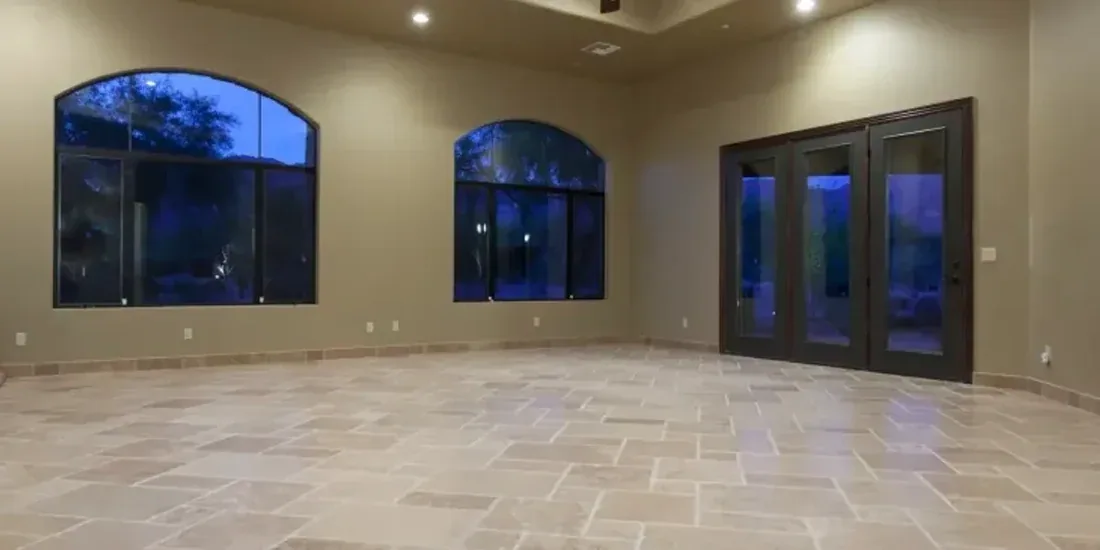
Travertine
The most common stone in Paradise Valley by a wide margin, and the most forgiving of the calcium carbonate stones to clean.
Its defining feature is natural voids. Travertine forms with holes in it, and most flooring travertine is factory-filled with a resin or cement compound to produce a flat surface.
That fill is the thing to watch. Over years it works loose and falls out, leaving open pits that collect soil and hold water. Cleaning does not put fill back, and where a floor has lost a lot of it we will point that out, because it changes what the finished result will look like.
Travertine is also the best candidate for color enhancing sealer there is. It goes flat as its sealer wears and the enhancing option brings back depth and variation more dramatically than on any other stone.
Marble
The least forgiving surface in a house, entirely because of the finish rather than the material.
Polished marble reflects light evenly, so any dull spot stands out immediately and from a distance. The same etch on honed travertine would be nearly invisible. Nothing about marble makes it more chemically vulnerable than travertine, it simply shows what happens.
It is also where the highest proportion of damage-by-cleaning-product happens, because polished marble frequently ends up in bathrooms and kitchens where acidic products live.
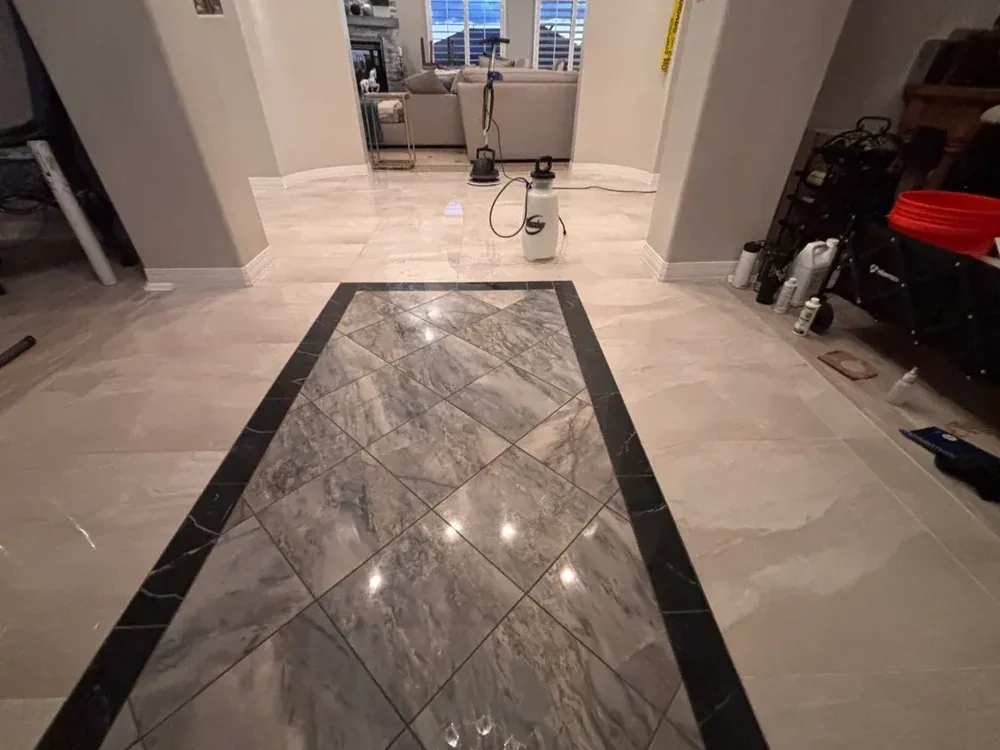
Limestone
Chemically similar to marble, softer than both marble and travertine, and the one most likely to show wear as physical abrasion rather than just soil.
It is usually honed rather than polished, which hides etching better than marble does, and it tends to be chosen in pale colors that show soil readily. The combination means a limestone floor can look genuinely dirty while being in perfectly good condition, which makes it one of the more satisfying stones to clean.
Slate
The outlier, because it is not calcium carbonate and does not etch the way the others do.
Its own problem is spalling, where thin layers lift and flake away from the surface. Slate is formed in layers and it comes apart the same way, and aggressive cleaning accelerates that considerably.
Slate is also the second-best color enhancing candidate after travertine. Slate that has gone gray and flat comes back with real depth and the variation between pieces returns.
Engineered stone and stone-look porcelain
Increasingly common and worth identifying, because it is genuinely good news.
Porcelain made to look like travertine or marble has a fired glaze. It does not etch, it does not absorb, and it does not need sealing. If that is what you have we will tell you, and the job is simpler and cheaper than a stone job.
The reason it matters is the reverse case. A company assuming stone-look porcelain when a floor is actually marble will use a product that etches it.
How we tell them apart
- Look at the edges and cut faces. Natural stone has consistent structure through the body. Porcelain has a glazed top over a different-colored biscuit.
- Look at repetition. Stone-look porcelain repeats its pattern across a floor. Genuine stone does not, because every piece came out of the ground differently.
- Look at the pores. Travertine has voids and fill. Limestone has fine even texture. Marble has veining that runs through rather than sitting on the surface.
- Test in a concealed spot where there is any doubt, before anything is applied to the visible floor.
What they have in common
Three of the four are calcium carbonate, so travertine, marble and limestone all share the same vulnerability: acid dissolves them on contact. Slate does not, and porcelain does not.
Since a homeowner cannot be expected to know which product is acidic, the practical answer is pH-neutral on everything. That is what we do and it is why the question of what a company uses matters more than almost anything else you could ask them.
Questions
How do you identify my stone?
By appearance, by how it takes light, by hardness, and by a controlled test in a concealed area where there is doubt. Travertine, marble, limestone and slate all look different up close once you know what to look for.
Does it really matter which one I have?
It determines the products, the method and what result is achievable. The cleaner that suits slate can dull limestone, and any acidic product damages three of the four on contact.
Which is the most fragile?
Polished marble shows damage most, because a mirror finish makes any etch obvious. Limestone is the softest of the common stones. Slate is the most prone to flaking apart if handled aggressively.
What is travertine fill?
Travertine has natural voids, and most of it is factory-filled with a resin or cement compound. That fill can come loose over the years, leaving open holes that collect soil. We will point out where that has happened.
Can you tell marble from limestone?
Usually. They are chemically similar and behave similarly, which is convenient, because both need the same pH-neutral handling and both etch the same way.
What about engineered or porcelain that looks like stone?
Common now, and genuinely good news if that is what you have, because it does not etch and is far more forgiving. We identify it and tell you, and it usually means a cheaper and simpler job.
Calls answered 7am to 8pm · same-day service usually available
Free identification, and the right method chosen from it.